
St Dunstan’s celebrates Black History Month
The Church of England celebrates Black History month with this prayer
Compassionate God,
who sent Jesus Christ to deliver us from all manner of injustices and inequalities,
create in us new hearts and enlarged visions,
to see the image of God in every person
irrespective of background, race and ethnicity.
May we be generous in our love of others
as we work towards ending racism and injustice;
creating communities of human flourishing,
through Jesus Christ your Son our Lord,
who is alive and reigns with you,
in the unity of the Holy Spirit,
one God, now and for ever
Amen.

Life of Phillis Wheatley
In 1753, Senegambia was once my home,
If only I had known what was to become of me,
I would have surely relished and cherished every moment
Spent with my real family.
Playing innocently with adored friends,
Too engrossed to eavesdrop in on adult conversation,
I was comfortable with the realisation
That my world was deeply rooted
In the rich golden landscape of Africa’s Western coast,
As ‘Fatou’ I had a name that once spoke of an African heritage,
Profoundly enriched with a language I could call my own.
It never occurred to me that one day my comfort zone
Would be so savagely seized away from me,
But tragically and so mercilessly
Destiny was to meter out just this kind of blow.
For on one fateful day whilst skipping away from familiar ground,
I was surrounded by strange-looking men carrying guns,
Stunned and frightened
My silence was broken with a piecing yelp,
But absolutely no one came to help.
With irons around my wrists I was taken to a ship,
To be with others, bounded from head to toe,
And guarded by guns we had no where to go,
We prayed to our creator to set us free.
But even God ignored our pleas.
So on this ship so named the Phillis
Stripped of choice and our African voice,
We were forced to endure starvation, shame and sickness
And even though I was spared the shackles and chains,
It pained me all the same
To watch my people being treated in such a brutal way.
.
Across the seas for countless days and nights,
With my home completely out of sight,
The Phillis finally arrived in Boston, Massachusetts
On 11 July 1761,
When, scholars say, my recorded history had really just begun
Like a lamb devoid of its flock
I was paraded on an auction block
For white folk to examine
As though I were livestock,
But I was an African child,
Disgraced, displaced and defiled.
Then, mercifully, God delivered unto me
My mistress, sweet Susannah Wheatley,
Who was only too glad
To accept me into her benevolent family,
As a domestic slave and companion.
Thus, Phillis Wheatley became my trusted name.
There, with Mary Wheatley at my side
My adoptive sister and passionate tutorial guide,
I learnt with ease to read and write
And with such an insatiable appetite
Latin, Religion, English, Astronomy,
And especially poetry I mastered with such pride.
Influenced by my Christian faith
I wrote great elegies
That won enormous praise
From those few who marvelled
At my poetic skill,
While many more refused to accept
I really was for real.
Embattled by a racist onslaught,
I had to defend my work in court,
But after close inspection and much discussion
All accept I was indeed
The owner of such creative thought.
So eager was I for recognition,
I posted some poems,
Secretly over to London,
Where my mistress’ friend,
The Countess of Huntington
Read my work with much excitement.
Highly impressed the Countess
Helped to get my work published,
While back in slave-riddled Boston,
Publishers rejected my poetry
Time and time again.
Thus, on the invitation of my mistress’ friend,
With Mary’s brother, Nathanial I travelled to England,
To promote my book
And joined the abolitionist trend.
Suddenly I felt like a celebrity
Meeting various dignitaries,
In London, it seemed
Like I was free and not bounded down by slavery
But sadly, this freedom did not last long for me,
Once that fateful message came from overseas,
To say that my sweet mistress,
Susannah Wheatley,
Was close to death,
My life was also to change drastically.
I never did get to meet King George III or the Countess
Who contributed so much to my literary success.
Arriving back in the States
To be at my mother’s side,
My world rapidly collapsed that day
When Susannah Wheatley died.
A few months later, Master Wheatley also passed away.
So I was freed from bondage
And expected to move well on my way
With no family, no job, no home to call my own,
Freedom was a painful price to pay.
I worked for a while as a domestic servant
And met freed slave, John peters
Who, in 1778, became my husband.
Tragically, we lost two daughters after my delivery
Then while expecting a third baby,
My husband sadly felt the need to flee.
All these losses impacted on me tremendously,
My children, husband, the Wheatley family,
Were all inextricably linked to slavery,
And even though at 31 I was now living
In poverty, yet as ‘free’ as ‘free’ could be
Tragically in 1784 I lost my life giving birth to another girl,
Who also departed soon afterwards from my unjust world
At the time of death,
A second volume of my poetry
Simply vanished without trace.
Though thanks to future abolitionists
My life, works and contribution to black history
Has now found an international and eternal place.
Akuba 14th November 2007
Congregation member Cllr Grace Quansah shares her poem about a wonderful African poet
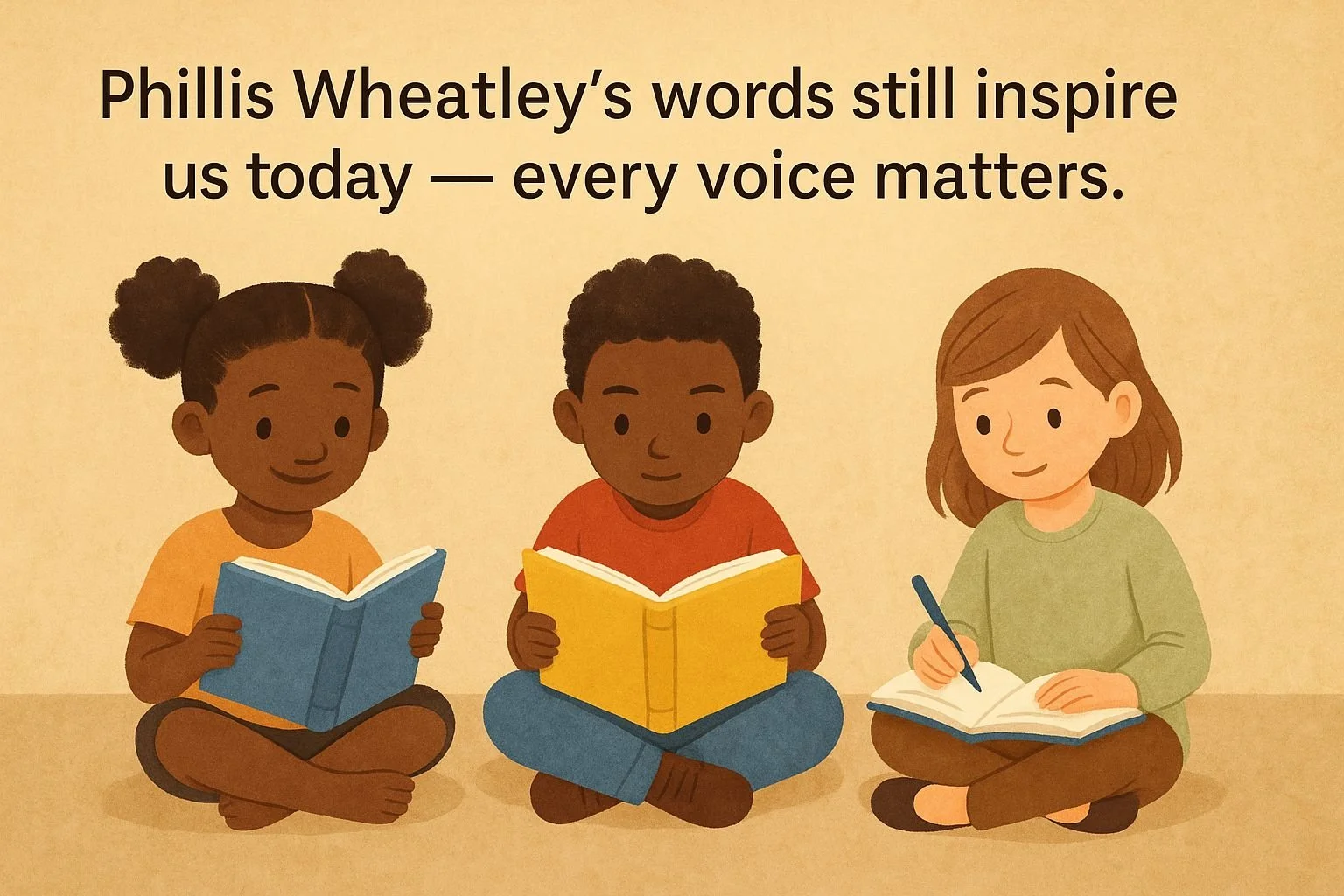
Child-friendly version
Phillis Wheatley: The Girl Who Loved Words
Once a girl from Africa’s shore,
she played and laughed, and dreamed of more.
But taken far across the sea,
Her heart still longed for liberty.
A kind new home, she learned to write,
Her poems shone with truth and light.
Through every test her faith stayed strong,
Her words of hope became her song.
Though gone so young, her voice lives still,
A poet brave, with love and will.
She showed the world what words can be—
A light for truth and dignity.

Read more about Phillis Wheatley . . .